
Articles
Key Signs Your Parent Needs “Awake at Night” Care
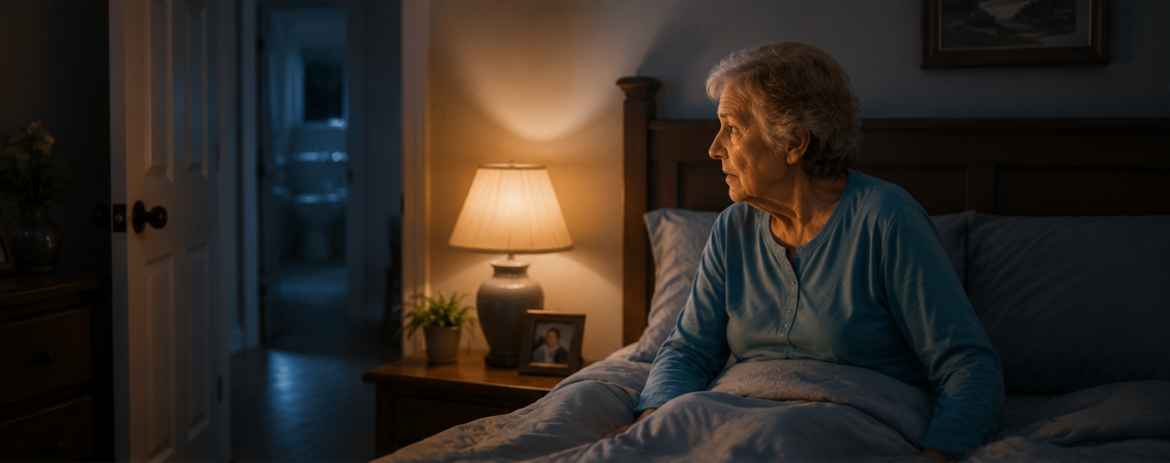
Is your aging parent safe at night? Learn the 4 hidden signs they need specialized, awake-at-night senior care in Scottsdale to prevent falls and disorientation.
For many families in Scottsdale, the realization that an aging parent needs daily support does not happen all at once during the day. It often happens in the quiet hours of the night.
During daylight hours, your parent might seem to manage relatively well. They can handle light conversations, navigate their kitchen, and keep up appearances when you visit. But as the sun sets, a different reality can emerge. Nighttime brings specific vulnerabilities—including confusion, sleep disturbances, and a significantly increased risk of falls.
When exploring your senior care options in Scottsdale, you will find that most standard assisted living environments use an "on-call" staffing model at night. This means caregivers sleep in the building or handle an entire wing alone, responding only after an automated alert or call button is pushed. For many seniors, this lag time is a safety hazard.
Here are the critical signs that your parent has outgrown standard care schedules and requires a community with a dedicated, fully awake-at-night care team.
1. The Onset of "Sundowning" and Late-Day Confusion
If you notice your parent becoming increasingly anxious, agitated, or confused as the afternoon turns into evening, they may be experiencing a behavioral phenomenon known as sundowning.
According to research published by the National Institute on Aging (NIA), sundowning is incredibly common in individuals experiencing early to mid-stage cognitive decline. It can cause seniors to pace, become suspicious of their surroundings, or desperately insist that they "need to go home" even when they are sitting in their own living room.
When a senior experiences late-day confusion, they cannot simply be told to go back to sleep. They require patience, environmental adjustments, and a reassuring human presence. In a large facility with on-call night staff, a pacing resident might go unnoticed for hours. In an intimate boutique home with awake-at-night caregivers, a staff member is physically present to brew a warm cup of tea, turn on familiar music, and gently guide them back to a state of calm.
2. Frequent Midnight Waking and Environmental Disorientation
Healthy sleep patterns often shift as we age, but chronic nighttime wakefulness can quickly become dangerous for a senior living alone or in an unmonitored environment.
Seniors frequently wake up in the middle of the night needing to use the restroom. In the dark, a minor cognitive fog can cause severe disorientation. Your parent might forget where the bathroom is, misjudge the height of the bed, or mistake a closet door for an exit.
The Alzheimer's Association notes that changes in the brain's internal clock can cause seniors to mix up day and night entirely. A parent might wake up at 3:00 a.m. completely convinced that it is time to cook breakfast, walk the dog, or head out to a doctor appointment. Having an awake caregiver present ensures these midnight wanderings are safely intercepted before your loved one opens the front door or attempts to use a hot stove.
Nighttime Situation | On-Call Staffing Model | Awake-at-Night Staffing Model |
|---|---|---|
Resident falls getting out of bed | The resident must be able to reach a call button, or wait until morning rounds. | A caregiver hears the movement or checks the room immediately to assist. |
Resident experiences sundowning | Staff is often unavailable to provide one-on-one reassurance or redirect behaviors. | A present caregiver can immediately sit with the resident, offer tea, and soothe anxiety. |
Midnight restroom assistance | Response times can vary widely depending on how many emergencies occur across the facility. | Intimate boutique ratios mean help arrives in seconds, preventing rushed, unassisted trips. |
3. A History of Falls or Near-Misses in the Dark
Falls are the leading cause of injury among older adults, and the risk multiplies exponentially in the dark. A senior with limited mobility, poor balance, or low night vision faces an immense challenge trying to navigate a bedroom safely at night.
Many families try to bridge this gap at home by installing motion-activated lights, bed rails, or pressure mats. While helpful, technology cannot replace human hands. If your parent has a history of unsteadiness, or if you have found bruises they cannot quite explain, they are at an immediate risk for a life-altering injury.
Data compiled by the Centers for Disease Control and Prevention (CDC) underscores that millions of older adults fall each year, often resulting in hip fractures or head traumas that severely impact their long-term independence. An awake-at-night care provider eliminates the window of vulnerability, ensuring that whenever a resident shifts to stand up, an alert, capable professional is right there to offer physical support

4. Caregiver Burnout Affecting Your Own Health
If you are currently acting as the primary nighttime caregiver for your parent, you know the immense toll it takes. Waking up every time you hear a noise down the hall, or lying awake wondering if your parent is safe in their own home miles away, leads to profound exhaustion.
Sleep deprivation impairs your health, your career, and your relationships. More importantly, it can inadvertently make you less patient during the day with the parent you love so dearly. Moving your loved one to a community with an awake night staff isn't an admission of failure. It is an intentional choice to hand the exhausting logistical watch over to professionals so you can reclaim your role as a son or daughter.
Finding the Right Fit in Scottsdale
When a senior requires true twenty-four-hour monitoring, the scale of the community matters immensely. Massive, multi-story senior living complexes are physically difficult to monitor continuously at night.
Boutique residential care homes offer an entirely different level of security. Because these settings are intimate private residences typically limited to around ten residents, an awake night caregiver can easily monitor the entire home. They can hear a bedroom door open or a rustle of blankets instantly, providing a level of proactive protection that an institutional building simply cannot match.
If your family is feeling the strain of sleepless nights and worries about nighttime safety, we invite you to connect with our team at Torbrook Assisted Living. Across our three cozy, small-scale Scottsdale properties, we maintain a dedicated, fully awake-at-night care staff. Let us carry the night shift so you and your parent can finally sleep with complete peace of mind.
Explore Luxury Assisted Living at Torbrook
Discover how our family-owned residential environments can accommodate your loved one:
- Explore Our Homes: Meet our Team or read our specialized Blogs to see our thoughtfully designed living spaces.
- Tour Our Scottsdale Locations: Contact our office to arrange an in-person visit to evaluate our senior-safe environments.
- Discuss Your Layout Needs: Speak directly with our leadership team about your parent’s care timeline and pet requirements.
Call our team today or message us through our contact page to learn more about our family-owned assisted living standard in Scottsdale.
See also:
- Safety, Dignity, and Ease: Why Assisted Living is Essential for Physically Challenged Seniors
- Enhancing Quality of Life: The Benefits of Specialized Memory Care
- The Benefits of Personalized Living Spaces in Assisted Living Communities
- When Is the Right Time to Choose Assisted Living for Seniors?
- Why Scottsdale is Ideal for Senior Assisted Living
- The Added Value of Luxury Living in Assisted Living Communities
Author: Torbrook Assisted Living Team